Performance podcast advertising tends to attract two kinds of reactions. Some marketers see it as an underused growth channel with unusually high trust and strong audience intent. Others see it as difficult to measure, expensive to test, and far less predictable than search or paid social. The truth, as usual, sits somewhere in the middle. Podcast ads can absolutely drive measurable actions—trials, purchases, sign-ups, demos—but they usually do so in a way that is more human and less tidy than many performance teams are used to.
That is what makes the channel both useful and easy to misunderstand. A listener may hear a host recommendation while driving, ignore it in the moment, search the brand later, and convert after seeing it again elsewhere. If you only measure the final click, the podcast gets undervalued. If you assume trust alone will do the selling, the campaign often underperforms. The brands that do well with performance podcast advertising are usually the ones that treat it seriously: as a measurable channel, yes, but also as one that depends heavily on fit, timing, repetition, and what happens after the ad.
Why Performance Podcast Advertising Works Differently From Brand Podcast Ads?
Before anything else, it helps to separate performance podcast advertising from general podcast sponsorship. They are related, but they are not the same thing. A brand-focused campaign may aim to increase awareness or improve recall over time. A performance-focused campaign is trying to drive a specific action tied to spend—something measurable enough to justify the budget.
That action might be a free trial, a product purchase, an app install, a booked demo, or a paid subscription. The difference sounds subtle, but it changes how the campaign should be built. You are no longer asking whether people heard the ad. You are asking whether the right listeners were persuaded enough to act, and whether the economics of that action make sense. That requires more discipline in how you choose shows, structure the offer, and judge results.
5 Key Things to Know About Performance Podcast Advertising
Performance podcast advertising works best when it is treated as a serious acquisition channel rather than just another brand play. The results often depend less on hype and more on a few practical factors—who you target, how the ad is delivered, what you are measuring, and whether the offer is strong enough to convert interest into action. These five points are where most campaigns either start making sense or start losing money.
Audience Fit Usually Outperforms Audience Size
One of the most common mistakes in performance podcast advertising is buying based on popularity instead of relevance. A large podcast can look impressive on paper, especially in internal discussions where big download numbers feel reassuring. But bigger does not always mean better. In many cases, a smaller show with a more aligned audience will produce stronger conversion results than a much larger show with weaker intent.
This is especially true in categories like SaaS, personal finance, education, health, and niche consumer products. A software tool for startup founders may perform modestly on a broad business podcast but do far better on a smaller operations or bootstrapping show. The same pattern shows up in wellness and productivity brands. According to Acast campaign reporting published in 2023, advertisers often see stronger engagement from contextually relevant podcast placements than from broad inventory buys. In practical terms, performance podcast advertising rewards precision much more than reach.
Host-Read Ad Creative Often Makes or Breaks Results
The creative side of performance podcast advertising is often underestimated, especially by teams used to display or paid social. On podcasts, the ad is not just the message. It is also the delivery, the tone, and whether the recommendation sounds believable in that host’s voice. That is one reason host-read ads tend to outperform generic pre-produced inserts. They feel less like interruptions and more like informed recommendations.
A good host-read ad usually does three things well: it explains the product clearly, gives the listener a reason to care now, and sounds like something the host would genuinely say. That last part matters more than many brands are comfortable admitting. If the script becomes too polished or too legally cautious, it often loses the very quality that makes podcast ads effective. A good example is how companies like HelloFresh and BetterHelp became highly recognizable through repeated host-read ads between 2020 and 2024. The campaigns worked not just because the brands advertised widely, but because listeners heard them explained in a familiar, conversational format.
Attribution Will Never Be Perfect—So You Need Multiple Signals
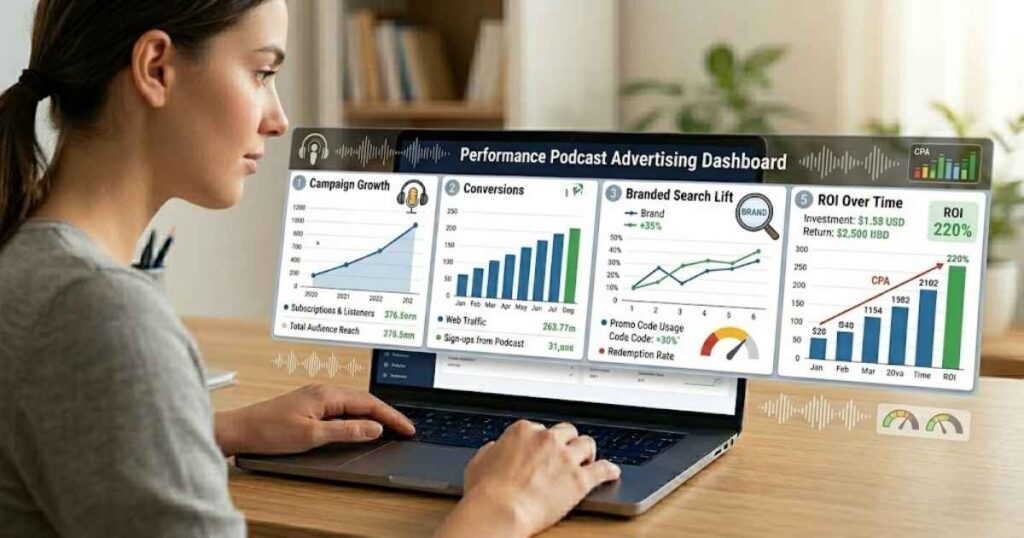
This is where many teams either become too optimistic or too cynical. Performance podcast advertising is measurable, but not always in a clean, single-source way. Yes, you can track promo codes, vanity URLs, landing page visits, and post-purchase surveys. Those are useful. But many listeners will still convert in less direct ways. They hear the ad, remember the brand, search for it later, and sign up through another channel. That is normal behavior, not broken attribution.
The smarter approach is to look for patterns, not just isolated numbers. For example, did branded search increase after the campaign launched? Did direct website traffic rise on the days new episodes aired? Did leads from podcast listeners convert better than average once they entered the funnel? According to Edison Research in 2023, a significant share of podcast listeners report taking follow-up actions after hearing podcast ads, including visiting a website or searching for the brand. That means podcast ROI often lives in a combination of signals rather than one obvious metric.
The Offer and Landing Page Usually Matter More Than the Podcast Buy
A lot of underperforming podcast campaigns are blamed on the wrong thing. The podcast gets blamed when in reality, the problem often sits further down the funnel. A listener hears the ad, gets curious, visits the site, and then finds a vague landing page, a confusing value proposition, or a high-friction sign-up process. At that point, even a strong podcast placement can struggle.
This happens more often than teams expect. A good performance podcast ad creates interest, but it usually does not create infinite patience. The listener often arrives with only moderate intent and partial memory of what they heard. That means your landing page needs to do the heavy lifting quickly. A clear headline, a simple offer, visible proof, and an easy next step matter far more than many brands realize. If your conversion path is weak, podcast ads will not hide that. They will expose it.
Repetition and Timing Matter More Than One-Off Placements
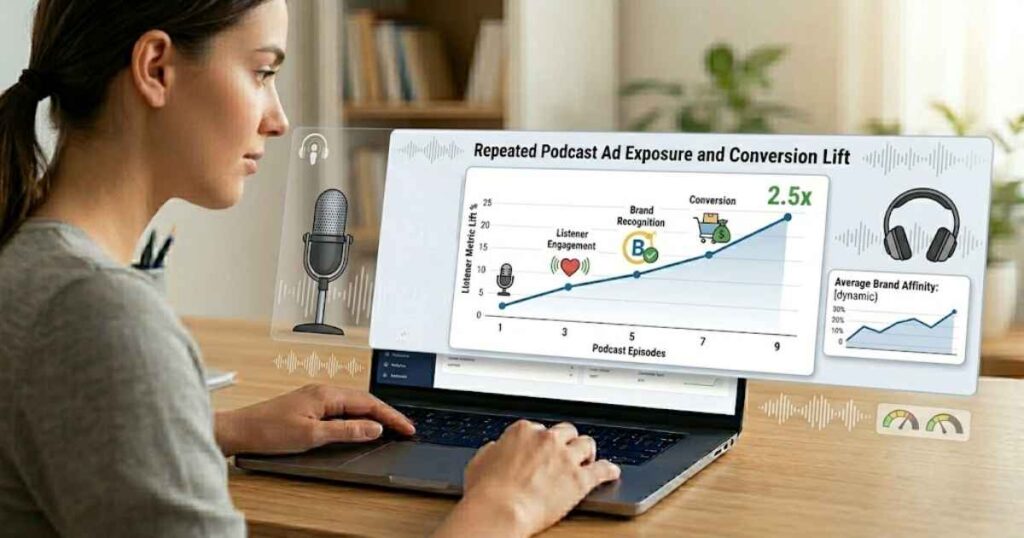
One podcast ad is rarely enough to judge the channel fairly. That is one of the biggest realities of performance podcast advertising. Listeners often need more than one exposure before they act, especially if the product is unfamiliar or the purchase is not urgent. The first ad creates awareness. The second or third often creates recognition. That recognition is usually what improves conversion.
This is why experienced advertisers often buy multi-episode runs rather than one isolated placement. Repetition creates memory, and memory improves response. That does not mean repeating the same script forever—too much repetition can lead to ad fatigue—but underexposure is often the more common problem. A strong example of this pattern can be seen in recurring podcast advertisers like Shopify and Squarespace, which benefited from repeated placements across business, creator, and entrepreneurship podcasts over several years. Their ads became effective partly because listeners heard them often enough to remember them when the need became real.
How HelloFresh Turned Podcast Advertising Into a Performance Growth Channel?
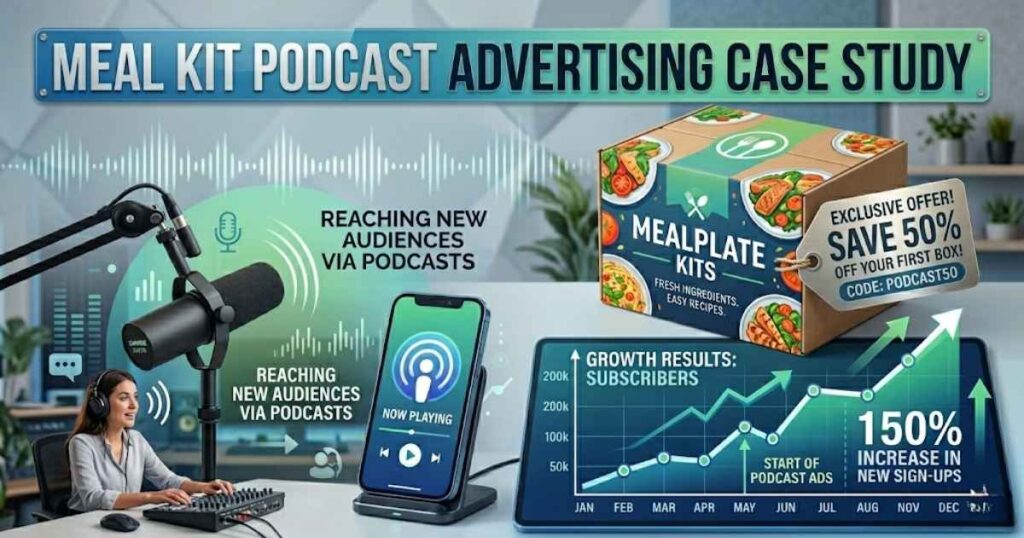
One of the clearest examples of performance podcast advertising working at scale is HelloFresh. Between 2020 and 2023, the company invested heavily in podcast ads across business, lifestyle, fitness, and comedy shows. If you followed podcasts during that time, the pattern was hard to miss—hosts describing meal kits in a personal tone, paired with clear discount codes and first-box offers. What made this effective was not just repetition, but how easily the product translated into audio. Listeners could quickly understand the value without needing visuals, which is a major advantage in podcast advertising.
From a performance standpoint, HelloFresh didn’t rely on a single metric. Instead, it combined direct tracking with broader behavioral signals, which is exactly how most successful podcast campaigns are measured in practice.
How HelloFresh drove measurable performance:
- Clear, trackable offers: Each ad included discount codes (e.g., “Get 50% off your first box”), making it easy to measure immediate conversions.
- Strong product-market fit for audio: The concept—pre-portioned ingredients delivered to your door—was simple enough to explain in 30–60 seconds.
- Host-read authenticity: Ads were delivered in the host’s voice, often framed as a personal experience, which improved trust and recall.
- Multi-episode repetition strategy: Instead of one-off ads, HelloFresh ran campaigns across multiple episodes and shows, increasing familiarity over time.
- Cross-channel impact: Many listeners didn’t convert immediately but later searched the brand or visited directly, contributing to overall growth.
This approach aligned with broader industry trends. According to the Interactive Advertising Bureau, U.S. podcast ad revenue grew by over 115% from 2020 to 2022, showing that more brands were using podcasts as a serious performance channel—not just for awareness. At the same time, HelloFresh also highlights the limits of scaling podcast advertising too aggressively.
Where challenges started to appear:
- Ad fatigue from repetition: Listeners began hearing similar scripts across unrelated podcasts, which reduced novelty and engagement.
- Loss of contextual fit: Ads placed on loosely related shows felt less relevant, weakening performance compared to niche placements.
- Perceived overexposure: The brand became “everywhere,” which can reduce the sense of authenticity that makes podcast ads effective.
The takeaway is practical. HelloFresh succeeded because it combined simple messaging, strong offers, and consistent exposure, but its scale also shows that performance podcast advertising requires balance. Repetition builds results—but only when it stays relevant, varied, and aligned with the audience.
Conclusion
Performance podcast advertising can absolutely drive measurable growth, but it rarely works as a “set it and forget it” channel. It performs best when brands understand what makes it different: trust matters more, audience fit matters more, repetition matters more, and clean attribution matters less than many teams initially expect. That does not make it vague. It just makes it more realistic.
The brands that tend to get the most from podcast advertising are usually the ones that stop treating it like an experiment and start treating it like a serious performance channel with its own rules. With EASI Ads, brands can approach podcast advertising in a more focused way, from finding the right audience fit to building campaigns that are easier to measure and improve over time. When the audience is right, the host is credible, the offer is clear, and the funnel is ready, podcast advertising can become one of the more effective and durable growth channels in the mix.
FAQs About Performance Podcast Advertising
What is performance podcast advertising?
Performance podcast advertising is a results-focused form of podcast marketing where the goal is to drive a measurable action rather than just increase brand awareness. That action could be a product purchase, free trial, app install, demo booking, or subscription. Unlike general podcast sponsorships that are often aimed at visibility and recall, performance campaigns are judged by how effectively they turn listener attention into trackable business outcomes.
How is performance podcast advertising different from brand podcast advertising?
The main difference is the objective. Brand podcast advertising is usually designed to improve recognition, trust, and long-term awareness, while performance podcast advertising is intended to generate direct and measurable results. In practice, however, the two often overlap. A podcast ad may drive both immediate conversions and long-term brand lift, which is why many advertisers measure it using a mix of direct response data and broader audience behavior.
Is performance podcast advertising actually effective?
Yes, performance podcast advertising can be highly effective when the product, audience, and offer are well aligned. It tends to work especially well for products that are easy to explain in audio and benefit from host trust, such as subscription services, software tools, finance apps, wellness brands, and online learning platforms. The strongest results usually come from niche audience fit, clear messaging, and repeated exposure rather than one-off placements.
How do you measure the ROI of performance podcast advertising?
ROI is typically measured through a combination of direct and indirect signals. Direct tracking may include promo codes, custom URLs, landing page conversions, and free trial sign-ups. Indirect indicators often include branded search growth, website traffic patterns, assisted conversions, and customer surveys. Because podcast ads often influence buying decisions over time, the most accurate measurement usually comes from looking at multiple signals together rather than relying on one metric alone.
What kind of businesses benefit most from performance podcast advertising?
Performance podcast advertising tends to work best for brands with products or services that are easy to describe clearly and quickly. This includes DTC brands, subscription businesses, SaaS tools, online education platforms, health and wellness products, and finance-related services. It can also work for B2B companies, especially when the audience is highly niche and the podcast has strong trust with decision-makers.
What are the biggest mistakes brands make with performance podcast advertising?
One of the most common mistakes is choosing podcasts based on audience size instead of audience fit. Other frequent issues include over-scripted ad reads, weak landing pages, unclear offers, poor attribution expectations, and testing too little before scaling. Many campaigns underperform not because podcast advertising is ineffective, but because the surrounding strategy—creative, targeting, or conversion path—was not strong enough to support it.