Advertising has changed how businesses reach customers. Earlier, companies depended on television, print media, and billboards to build awareness. Today, people discover brands through search engines, social media, streaming platforms, and online communities. Since consumers spend a large portion of their time online, advertising has become a powerful way to attract attention and influence buying decisions.
However, simply running ads is not enough. Many businesses fail to see results because their campaigns lack a clear strategy. Effective advertising focuses on understanding the audience, delivering relevant messages, and using the right platforms to improve conversions and build long-term brand recognition.
What is an advertising strategy?
An advertising strategy is a structured plan that guides how a business promotes its products or services online. It involves identifying the target audience, selecting the most suitable platforms, crafting clear messaging, and setting measurable goals to track success. Without a defined strategy, advertising efforts can become scattered and fail to deliver meaningful results
A strong strategy also considers the customer journey—how people discover, research, and decide on products, so businesses can deliver the right message at the right moment. In addition, effective advertising strategies rely on performance data, such as engagement and conversion metrics, to refine campaigns and continuously improve results.
10 Effective Advertising Strategies Businesses Use Today
Promoting a business online is no longer limited to running a few ads and hoping for the best. Today, companies have access to a wide range of advertising methods that help them reach specific audiences, measure performance, and improve results over time.
While there are countless tactics available, some strategies consistently deliver stronger outcomes than others. These approaches help businesses attract potential customers, build brand awareness, and generate measurable growth. Below are ten advertising strategies that many businesses rely on to achieve consistent results.
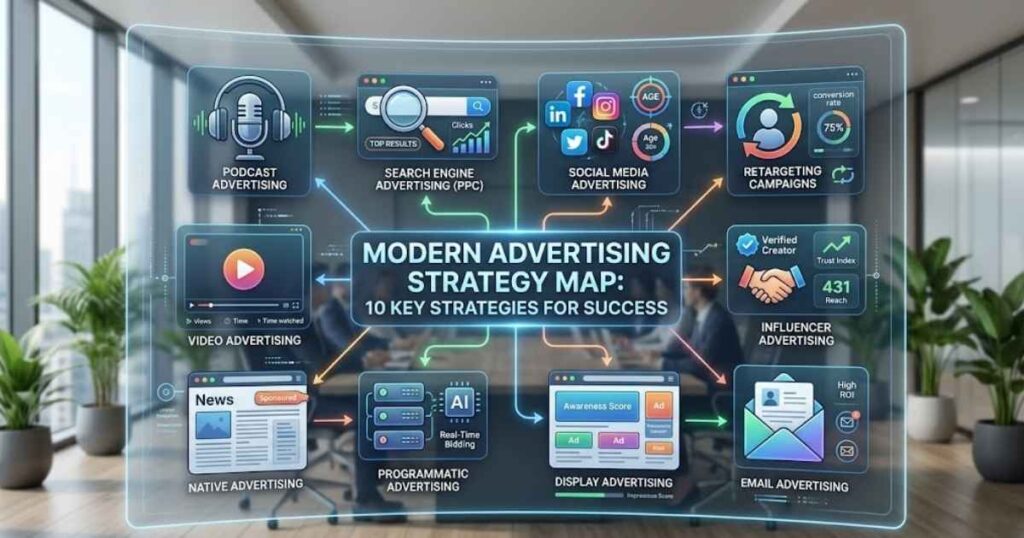
Podcast Advertising
Podcast advertising allows brands to promote their products or services within podcast episodes, reaching listeners in a more personal and attentive setting than many traditional digital ads. Since podcasts are often part of daily routines like commuting or exercising, audiences tend to be more engaged, and the trust they build with podcast hosts can make ad messages feel more genuine, credible, and effective for both brand awareness and conversions.
Common forms of podcast advertising
- Host-read ads: The podcast host delivers the ad in their own voice, often adding personal context or experience to make the message feel natural.
- Pre-recorded commercials: Brands provide professionally produced ad spots that are inserted into episodes before, during, or after the main content.
- Sponsored episodes: A full episode or a large portion of it is created in partnership with a brand, often centered around a relevant topic.
- Branded podcast segments: A recurring section of a podcast is sponsored by a company, helping the brand stay visible over time.
Why does this strategy work?
- Builds strong audience trust: Podcast listeners tend to trust the hosts they follow regularly, which makes brand messages feel more credible and less forced.
- Reaches highly engaged niche audiences: Podcasts are often built around specific interests, industries, or communities, allowing advertisers to target listeners more precisely.
- Creates a less disruptive ad experience: Unlike display ads or pop-ups, podcast ads are woven into content people have already chosen to consume.
- Improves message retention: Audio content often holds attention for longer periods, which can help listeners remember both the brand and the offer.
- Supports both awareness and conversions: Podcast advertising can introduce a brand to new audiences while also driving measurable action through promo codes, custom URLs, or direct calls to action.
Podcast advertising works especially well for brands that want to sound more human, trustworthy, and relevant. It is not just about reaching people at scale. It is about reaching the right audience in a format that feels conversational and credible. When the host, audience, and brand are aligned, podcast advertising can do more than generate clicks. It can build familiarity, influence buying decisions, and create lasting brand recall.
Search Engine Advertising (PPC)
Search engine advertising, commonly known as pay-per-click (PPC) advertising, allows businesses to place ads within search engine results pages. These ads appear when users search for keywords related to a product, service, or problem they want to solve.
What makes this strategy especially effective is the intent behind the search. When someone types a query like “best project management software for startups,” they are already looking for possible solutions.
Key advantages of search engine advertising
- Reaching users at the moment of intent: Ads appear exactly when users are actively searching for information, products, or services.
- Precise keyword targeting: Businesses can choose specific keywords that trigger their ads, ensuring the message reaches relevant audiences.
- Clear performance tracking: Marketers can monitor impressions, clicks, conversions, and cost per acquisition to evaluate campaign effectiveness.
- Flexible campaign control: Advertisers can adjust budgets, bids, or targeting quickly based on performance data.
Because of its ability to capture high-intent traffic, PPC is often one of the most valuable advertising channels for businesses seeking immediate results.
Social Media Advertising
Social media advertising has become a central part of modern marketing strategies. Platforms like Instagram, Facebook, LinkedIn, and TikTok attract billions of active users each day, offering brands enormous opportunities to connect with audiences. Unlike traditional advertising channels, social platforms allow businesses to deliver highly personalized ads to very specific groups of people.
Why is social media advertising widely used?
- Advanced audience targeting: Advertisers can target users based on age, location, interests, occupation, behavior, and many other characteristics.
- Multiple ad formats: Brands can experiment with images, videos, carousel ads, stories, and short-form video content.
- Strong engagement potential: Social media encourages interaction through likes, comments, shares, and messages.
- Campaign flexibility: Businesses can design campaigns for different objectives, such as brand awareness, website traffic, lead generation, or sales.
Because people spend a significant portion of their daily online time on social media, these platforms provide powerful opportunities for businesses to reach potential customers.
Retargeting Campaigns
Most visitors do not convert during their first visit to a website. They may browse products, compare options, or simply gather information before leaving. Retargeting campaigns focus on reconnecting with these users after they leave the site.
How does retargeting work?
- When a user visits a website, tracking technology records that interaction.
- After leaving the site, the user begins seeing ads for the same brand on other websites or social media platforms.
- These ads remind the user about the product or service they previously viewed.
Benefits of retargeting campaigns
- Targeting warm audiences: The ads reach people who have already shown interest in the brand.
- Higher conversion potential: Because the audience is already familiar with the product, they are more likely to complete a purchase.
- Improved return on advertising spend: Retargeting focuses on users closer to making a buying decision.
- Recovery of lost opportunities: Businesses can bring back visitors who abandoned carts or left without taking action.
For many companies, retargeting plays a critical role in maximizing the value of website traffic.
Video Advertising
Video has become one of the most influential forms of digital content. Platforms like YouTube, TikTok, and Instagram Reels prioritize video in their algorithms, which means well-produced videos often receive greater visibility. Video advertising allows businesses to communicate ideas quickly while creating engaging visual experiences.
Why is video advertising so effective?
- Stronger audience engagement: Moving visuals and sound naturally capture attention.
- Clear product demonstrations: Businesses can show how a product works instead of simply describing it.
- Storytelling opportunities: Videos allow brands to tell compelling stories that build emotional connections.
- Higher retention of information: People often remember video content better than static text or images.
Short-form videos, in particular, have become extremely effective because they deliver messages quickly and fit well within modern browsing habits.
Influencer Advertising
Influencer advertising involves collaborating with individuals who have established credibility and loyal followings within specific communities. Instead of traditional advertisements, influencers introduce products to their audiences through reviews, tutorials, or lifestyle content.
Reasons influencer marketing works well
- Established trust: Followers often value the opinions and recommendations of creators they regularly watch.
- Access to niche audiences: Influencers often focus on specific interests such as fitness, gaming, fashion, or technology.
- Authentic content integration: Promotions are often woven naturally into regular content rather than appearing as obvious ads.
- Higher engagement rates: Influencer audiences frequently interact with content through comments, shares, and discussions.
Brands frequently partner with influencers to introduce new products, demonstrate features, or create awareness within targeted communities.
Native Advertising
Native advertising integrates promotional content into editorial environments in a way that feels natural to readers. Unlike traditional banner ads, native ads match the design, tone, and format of the platform where they appear.
Examples of native advertising include
- Sponsored blog articles
- Recommended content sections
- Promoted posts within online publications
- In-feed advertisements on news websites
Advantages of native advertising
- Less intrusive advertising experience: The content blends seamlessly with the surrounding material.
- Higher engagement rates: Readers are more likely to interact with content that feels informative rather than promotional.
- Opportunity for education: Businesses can share helpful insights while introducing their product as a solution.
- Improved brand credibility: Informative content helps establish authority within an industry.
Native advertising works particularly well for businesses that want to build trust while promoting their expertise.
Programmatic Advertising
Programmatic advertising uses automated technology to purchase and place digital advertisements across multiple websites. Instead of manually negotiating ad placements, advertisers rely on platforms that use algorithms to determine where and when ads should appear.
How does programmatic advertising improve campaign efficiency?
- Automated ad buying: Software handles the process of purchasing ad space across various websites.
- Real-time bidding systems: Advertisers compete for ad placements instantly when users load webpages.
- Data-driven targeting: Ads are shown to users based on behavior, browsing history, and demographics.
- Continuous campaign optimization: Algorithms adjust bids and placements based on performance data.
For organizations running large-scale campaigns, programmatic advertising offers both efficiency and scalability.
Display Advertising
Display advertising includes visual ads that appear on websites, blogs, and mobile applications. These ads typically feature images, graphics, animations, or short promotional messages designed to capture attention.
How does display advertising support marketing efforts?
- Increasing brand visibility: Display ads introduce brands to audiences across different websites.
- Reinforcing brand recognition: Repeated exposure helps audiences become familiar with a company’s messaging.
- Creative visual communication: Graphics and visual elements make ads more noticeable.
- Integration with retargeting campaigns: Display networks often allow businesses to show ads specifically to previous visitors.
Although display ads may not always generate immediate conversions, they play a crucial role in building brand awareness.
Email Advertising Campaigns
Email marketing continues to be one of the most reliable digital communication channels available to businesses. Unlike many advertising methods that depend on third-party platforms, email allows companies to connect directly with people who have chosen to subscribe.
Benefits of email advertising
- Direct communication with interested audiences: Subscribers have already expressed interest in the brand.
- Personalized messaging: Emails can be tailored based on customer behavior, preferences, or past purchases.
- Versatile campaign formats: Businesses can send newsletters, promotions, product updates, or event invitations.
- Strong return on investment: Email marketing often delivers high ROI compared to many other digital channels.
When used consistently, email campaigns help nurture long-term relationships with customers.
How do Advertising Strategies Work?
Successful advertisement strategies follow a structured process rather than relying on guesswork. Businesses that approach advertising systematically are more likely to achieve consistent results and improve campaign performance over time.
Step 1: Audience Research
Every successful ad strategy begins with a deep understanding of the target audience. Businesses need to analyze who their customers are, what challenges they face, and how they behave online. This research often includes demographic insights, interests, search behavior, and purchasing patterns.
When marketers understand their audience well, they can craft advertising messages that speak directly to real needs and motivations. This relevance significantly increases the likelihood that users will engage with the advertisement.
Step 2: Platform Selection
Not every advertising platform works equally well for every business. Search engines, social media platforms, video streaming services, and display networks each serve different roles in the customer journey. Choosing the right platforms ensures that advertising budgets are spent where potential customers are most active.
For example, professional services may perform well on LinkedIn advertising campaigns, while consumer brands often find success on visual platforms such as Instagram or TikTok.
Step 3: Message Development
The most effective advertising strategies communicate value clearly and quickly. Digital audiences have limited attention spans, so advertisements must capture interest within seconds. This means focusing on benefits rather than technical details and presenting solutions to real problems.
Step 4: Campaign Testing
Testing is an essential part of modern advertising. Marketers often run multiple variations of ads to determine which headlines, visuals, or calls to action resonate most with the audience. These experiments provide valuable insights that help improve future campaigns.
Step 5: Continuous Optimization
Advertising platforms provide detailed analytics that reveal campaign performance. Businesses use this data to adjust targeting, refine messaging, and allocate budgets more effectively. Over time, these improvements lead to stronger campaign outcomes.
Real-World Examples of Advertising Strategies
Understanding advertising strategies makes more sense when you look at how businesses actually use them. Most companies don’t grow from just one channel—they combine a few that work together. Podcast advertising is often added as a support channel because it helps build trust and steady awareness over time.
Example 1: SaaS Company Using Podcast Advertising for Growth
A SaaS company offering project management software might initially depend on search ads to bring in users actively looking for solutions. Before using podcast advertising, results are usually stable but limited—traffic grows slowly, and conversion rates stay fairly average.
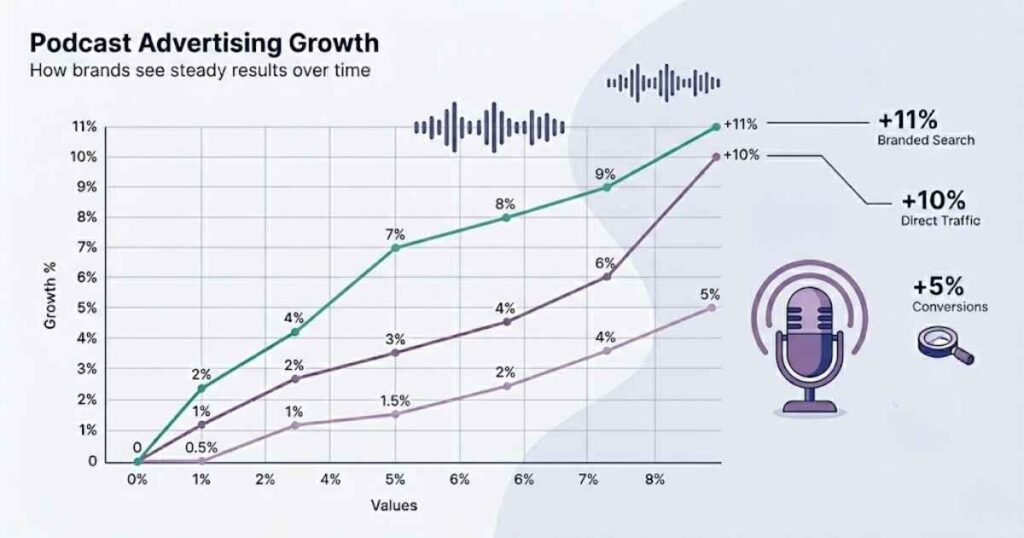
After testing podcast ads on relevant business or startup podcasts, the company may notice small but meaningful improvements over a few months. For example, branded search traffic might increase by around 5–12%, showing that more people are becoming aware of the brand. Free trial sign-ups could see a modest lift of 5–10%, mainly because listeners already have some level of trust when they visit.
Example 2: E-Commerce Brand Building Awareness Through Podcast Advertising
An e-commerce fashion or lifestyle brand might already use social media ads and influencers to drive traffic. These channels can bring quick visibility, but they don’t always build strong recall.
When the brand adds podcast advertising, the impact is usually gradual. Over time, it may see 5–15% growth in direct website visits, as listeners remember the brand and visit later instead of clicking immediately. Average order value might improve slightly by around 3–8% since podcast audiences often feel more confident about the purchase.
Overall, podcast advertising tends to deliver steady, realistic improvements rather than dramatic spikes. It works best as a long-term channel that builds trust and supports other marketing efforts, rather than replacing them.
Common Mistakes to Avoid in Advertising
Even well-planned campaigns can underperform if common mistakes are overlooked. Many businesses focus heavily on launching ads but pay less attention to strategy, targeting, and optimization. Avoiding these mistakes can significantly improve campaign performance and return on investment.
Key mistakes businesses should avoid:
- Targeting the wrong audience: Running ads without clearly defining the ideal customer often leads to wasted budget and low engagement.
- Ignoring data and analytics: Successful campaigns rely on performance data. Failing to track metrics such as clicks, conversions, and cost per acquisition makes optimization difficult.
- Using the same message for every platform: Each platform has a different audience and content style. Ads should be tailored to match the platform and user behavior.
- Not optimizing landing pages: Even great ads won’t convert if the landing page is slow, confusing, or poorly designed.
- Stopping campaigns too early: Advertising strategies often need time and testing before delivering consistent results.
FAQs About Advertising Strategies
Which advertising strategy is the most effective?
The effectiveness of a strategy often depends on the business type, target audience, and campaign goals. For example, search engine advertising works well for capturing high-intent users, while social media advertising is effective for building brand awareness. Many successful businesses combine several strategies, such as search ads, retargeting, and content marketing, to create a balanced approach.
How much should businesses spend on advertising?
There is no fixed budget for advertising because spending varies depending on the industry, competition, and campaign objectives. Many businesses begin with a smaller test budget, analyze the results, and gradually increase spending on strategies that deliver strong returns. The key is focusing on measurable outcomes such as leads, conversions, or sales.
How long does it take to see results from advertising?
Some strategies, such as pay-per-click advertising, can generate traffic almost immediately after launching a campaign. However, achieving consistent results often requires testing, optimization, and data analysis over time. Strategies like content-driven advertising or brand awareness campaigns may take longer but can produce lasting benefits.
Why is targeting important in advertising?
Targeting ensures that advertisements reach the most relevant audience instead of being shown to everyone online. By focusing on factors such as demographics, interests, location, and behavior, businesses can deliver more relevant messages. This improves engagement, increases conversions, and reduces wasted advertising spend.
Conclusion
Advertising offers businesses unprecedented opportunities to connect with customers and grow their brands. However, success depends on having a clear and thoughtful strategy rather than simply running ads across every available platform.
By implementing the 10 most effective advertising strategies outlined in this guide, businesses can create campaigns that attract attention, build trust, and drive meaningful results. The key is to start with a strong understanding of your audience, experiment with different approaches, and continuously refine your ad strategy based on data and insights.